Build
My work often involves a lot of repetition. So I built software for the science itself. Chorus is my local research agent: it runs analysis pipelines, plugs in new tools as modules, and records where every result came from.
Chorus
Many voices, one output.
A local personal agent in one executable. You talk to it in a terminal, the browser or Telegram. It works in a folder you choose, with tools under a permission policy you control, and every file it makes or reads is recorded with where it came from. The best part? The science itself is programmatic: every analysis can be rerun, inspected, and versioned.
Pipelines
A pipeline is a graph of steps you can build on a canvas, run once or in a batch, and rerun from any step. Pipelines run on a Go engine; each analysis step calls the tool selected for it (R/Bioconductor, Python).
geo-de-enrichmentA GEO series: sample checks, two groups compared (covariates, pairs), volcano, GO/KEGG, review, report.Rgeo-metaA batch of GEO comparisons combined: random effects, agreement, forest plots.RUnder developmentsc-rnaseqSingle-cell RNA-seq: QC, clusters, markers, CellTypist labels.PythonUnder developmentreads-to-countsOne RNA-seq run: ENA fetch, fastp, salmon, gene counts.Linux (WSL2)Under developmentnf-coreAny nf-core pipeline (rnaseq, sarek, bacass, crisprseq and others) with Nextflow and containers.Linux (WSL2)Under development
A recorded run
geo-de-enrichment on GSE30219, lung tumours against non-tumoral lung, as it ran on 2 October 2026. Step through it, or let it play.
program model (AI) you review compose * added after this run
- series
- GSE30219
- group_column
- source_name_ch1
- group_a
- Lung Tumour
- group_b
- Non Tumoral Lung
- lfc
- 1
- padj
- 0.05
01-fetch · reused
The expression matrix (probes × samples) and the sample table, from GEO.
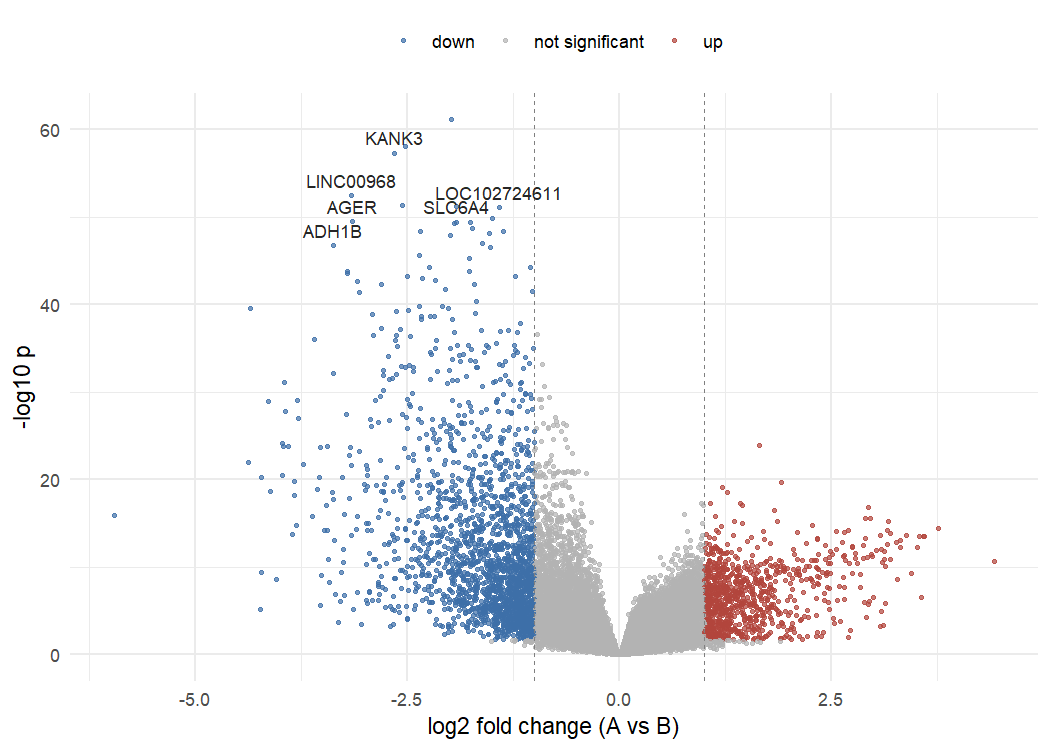
2,037 down · 896 up of 31,773 tested, adj. p < 0.05, |log2 FC| ≥ 1
| probe | gene | log2 FC | adj. p |
|---|---|---|---|
| 237390_at | — | -1.98 | 3.9e-57 |
| 239849_at | — | -2.52 | 2.1e-54 |
| 213715_s_at | KANK3 | -2.66 | 8.5e-54 |
| 243813_at | LINC00968 | -3.17 | 4.2e-49 |
| 220677_s_at | ADAMTS8 | -2.56 | 4.5e-48 |
The run waits here. It shows the top genes and the GO and KEGG tables, and goes on only when you approve.
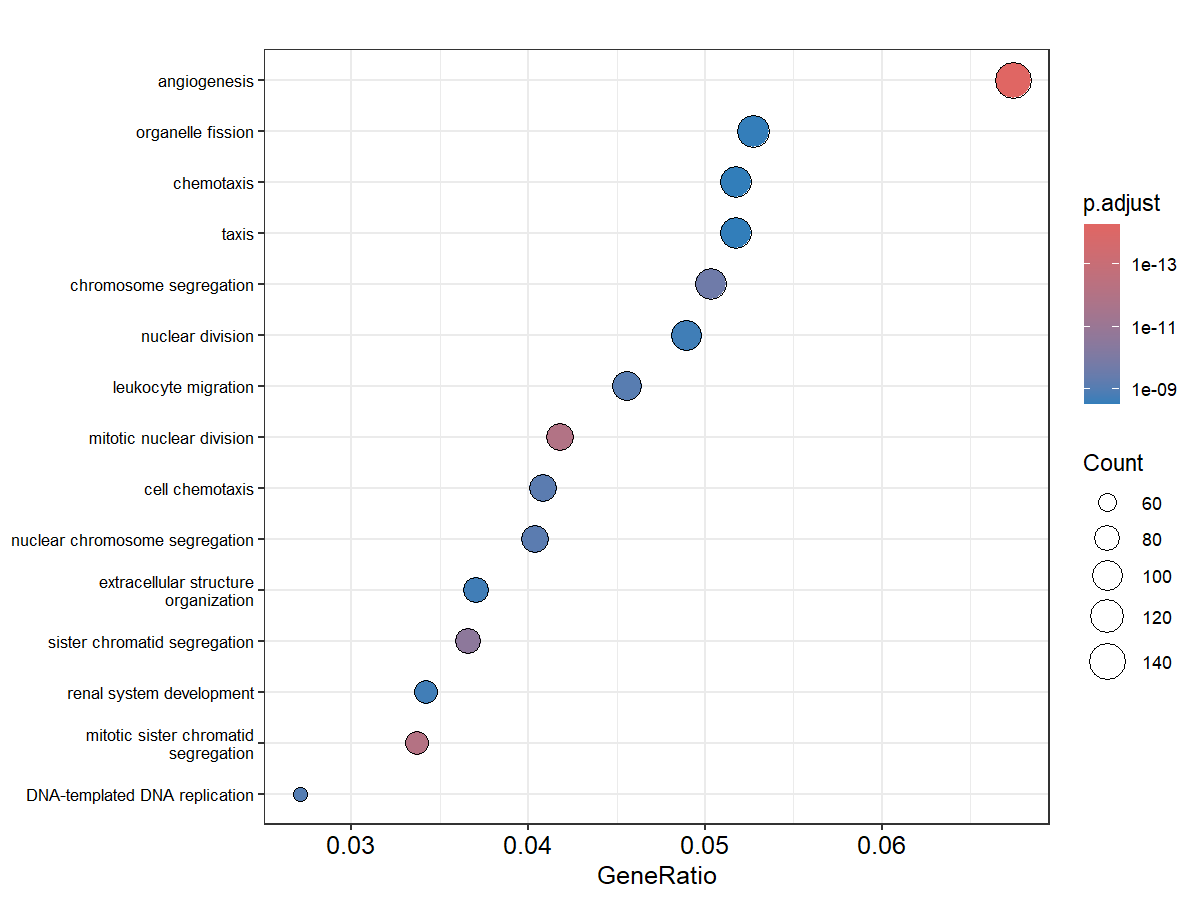
- angiogenesisGO · 142/2105 · 5.4e-15
- mitotic sister chromatid segregationGO · 71/2105 · 7.6e-13
- mitotic nuclear divisionGO · 88/2105 · 1.0e-12
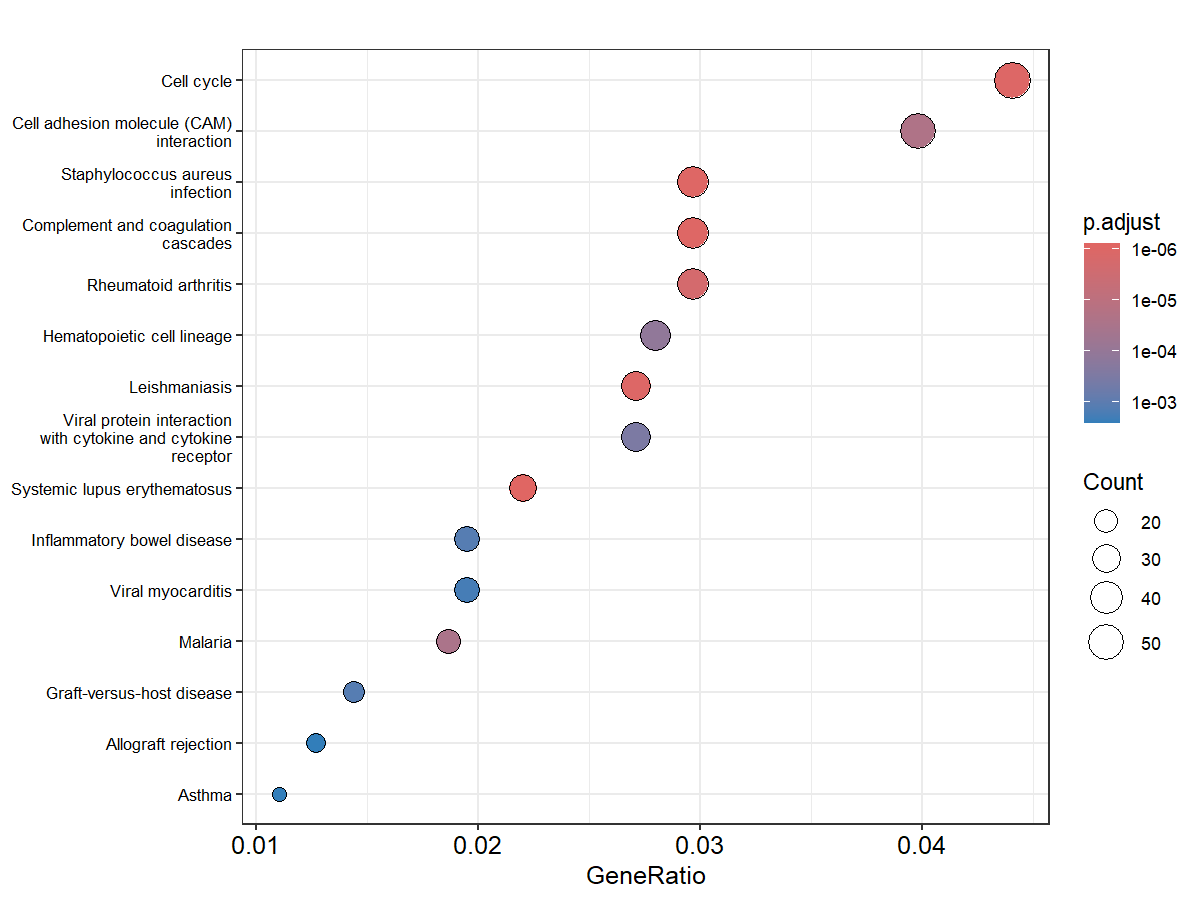
- Systemic lupus erythematosusKEGG · 26/1180 · 7.9e-7
- Complement and coagulation cascadesKEGG · 35/1180 · 9.4e-7
- Cell cycleKEGG · 52/1180 · 1.0e-6
06-summary/summary.md · written by a model, abridged
Analysis of GSE30219 shows strong differential expression with all top-ranked probes down-regulated (negative logFC).
The most significant probes were 237390_at and 239849_at, both unannotated, followed by the annotated genes KANK3, LINC00968 and ADAMTS8. Other highly significant down-regulated genes included AGER, SLC6A4, QKI, FAM107A, ADH1B and GPM6A.
GO biological process enrichment was strongest for angiogenesis and for cell-division terms: mitotic sister chromatid segregation, mitotic nuclear division, sister chromatid segregation and chromosome segregation. Also enriched were cell chemotaxis, leukocyte migration, DNA-templated DNA replication and extracellular matrix organization.
report.md and a self-contained report.html: the summary, the volcano, the top genes, and the GO and KEGG tables with their genes.
- report.md
- page.html
- table.csv
- go.csv
- kegg.csv
- run.json
Each file is recorded with its hash and the step that made it.
The geo-de-enrichment pipeline, redrawn from the file Chorus ships: its ten steps where the canvas places them, wired as the file wires them.
Modules
New capabilities are modules: a script, a program, an MCP server or a skill, in a folder of its own. They plug in without touching the core, and the agent loads one only when a task needs it. Chorus ships 10 of them, with 28 tools between them.
Script
Python, R, Julia, PowerShell or shell. Gets JSON on stdin, writes files into its output folder.
Program
Any executable, wrapped by a manifest.
MCP server
Its tools appear beside the others and pass the same approvals.
Skill
Instructions in a SKILL.md: a way of working, not a tool.
{
  "name": "omics",
  "version": "0.2.0",
  "kind": "script",
  "tools": [{
    "name": "volcano",
    "entry": "volcano.R",
    "risk": "low",
    "input": {
      "required": ["table"],
      "properties": { "table": {}, "lfc": {}, "padj": {} }
    },
    "outputs": { "plot": { "type": "png" } }
  }]
}chorus why report.mdBuilt in Go
Chorus is a single Go program. The engine that schedules and runs the pipelines is Go as well. And since it uses the native webview, there is no runtime to install.
| File | What it is | Size |
|---|---|---|
chorus-desktop.exe | the desktop workbench | 22.3 MB |
chorus.exe | the same runtime, for a terminal and the browser | 17.5 MB |
Chorus-Setup.exe | the installer | 16.0 MB |
- Go 63.3%
- JavaScript 21.9%
- CSS 6.3%
- R 3.2%
- Python 2.6%
- PowerShell 1.5%
- Shell 0.8%
- Other 0.5%
Principles
- New capabilities are modules (a script, a program, an MCP server or a skill) that plug in without touching the core.
- Every file a tool makes or reads is recorded with its hash and the call that made it, so any result traces back to its sources.
- Anything outside the session folder, a delete or an install asks first.
- It runs on free and local models, with one paid seat where it earns its cost.
Built as: One Go program, as a desktop app and a terminal tool, for Windows.
© 2026 Johan George Varghese. Chorus, its software, interface and the chorister are protected by copyright. All rights reserved.